Objectives
Build a Brand From Nothing
The client had the attorneys, the negotiators, and a four-person sales team. What he didn't have was a company. No website, no creative, no media presence, no way for a single customer to find him. Our objective wasn't to improve marketing — it was to create it, from the ground up.
Generate Leads Immediately, Not Eventually
This wasn't a brand-awareness play. A sales team was sitting idle, waiting for phones to ring. Every asset we built — website, radio spot, TV commercial — had one job: produce a qualified lead the moment it went live.
Diversify Beyond a Single Media Channel
Most companies get comfortable with the one channel that works, until that channel gets expensive or stops working. The objective from day one was to build a media strategy that didn't lean on any single platform to survive.
Turn a Seasonal Business Into a Consistent One
Tax relief is a seasonal industry by nature. The objective was to build lead flow that holds steady in the slow months and scales hard during tax season — without the volume spikes breaking the sales team's ability to close.
Sustain Profitability for the Long Haul
Anyone can produce a good month. The real objective was performance that holds up for years, not quarters — media buying and creative strategy that keeps paying off as the market, the platforms, and the competition all shift underneath it.
Challenges
Starting With Nothing
No website. No creative. No media presence. No brand. Before a single lead could be generated, an entire company's public-facing identity had to be built from the ground up — fast.
Proving the Model Before Scaling It
Local radio was the first bet. It had to work, and it had to work quickly, before any budget could justify expanding into national radio, TV, or digital.
Managing Extreme Seasonal Swings
Tax relief demand doesn't move in a straight line. Lead volume needed to flex from a steady baseline to over 1,200 leads a week during peak season — without the sales team drowning or the ad spend going to waste.
Avoiding Platform Dependence
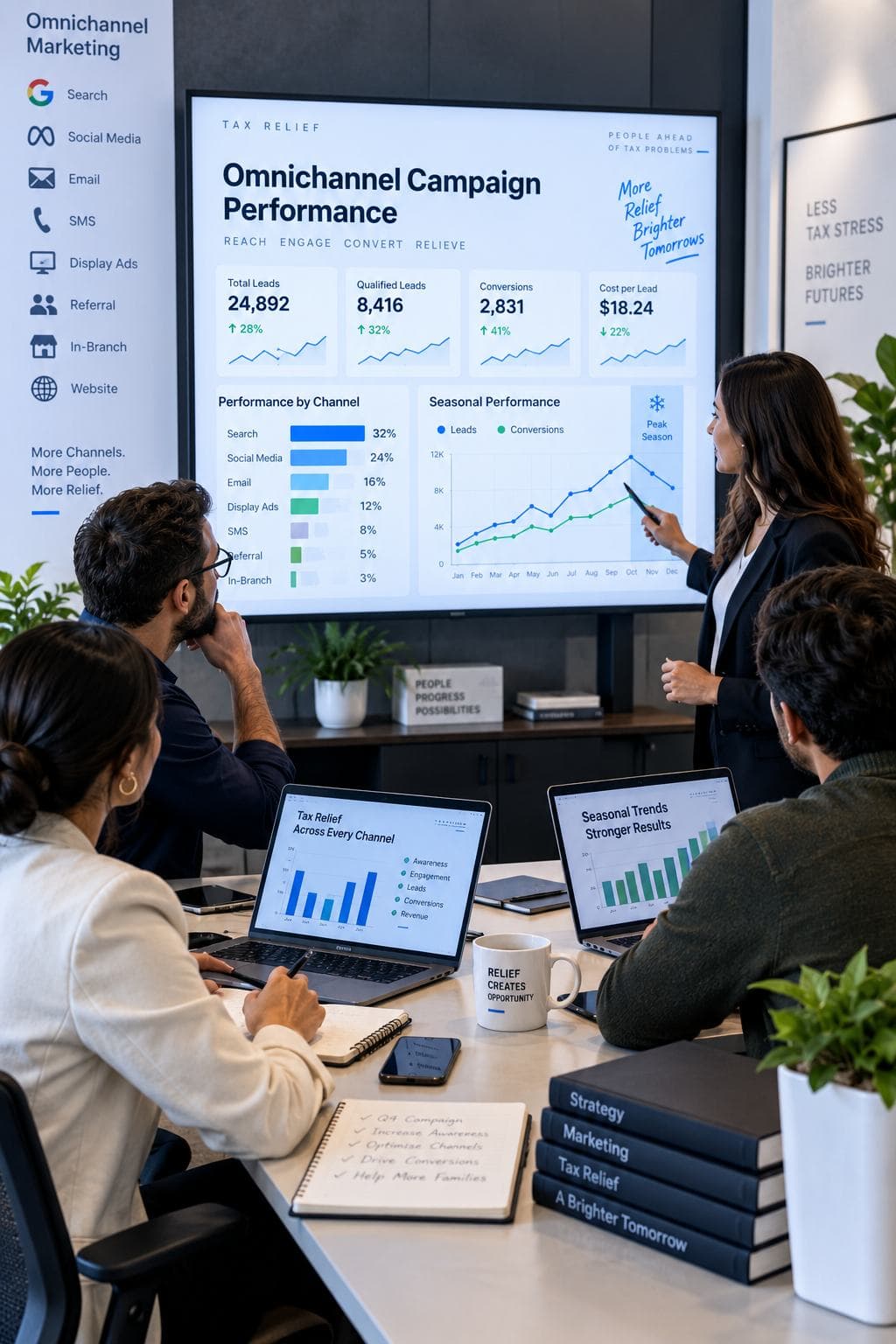
A single-channel strategy is a single point of failure. Building out Meta, Google, Amazon Prime, Local TV, National Cable, Local Radio, Network Radio, and Host Endorsement campaigns simultaneously — each with its own creative and buying strategy — meant no one channel could ever hold the business hostage.
Staying Profitable for 15 Years
Media costs rise. Platforms change. Audiences get harder to reach. The challenge was never getting one great year — it was engineering a strategy durable enough to keep producing 4.5X-plus ROAS more than a decade later.

Strategy & Solutions
Built the Company From the Ground Up
Website, radio creative, and TV ads were developed and launched together — not as marketing add-ons, but as the foundation of the business itself.
Proved It on Local Radio First
Within 4 weeks, local radio was generating 150–160 leads per week, giving us the proof and the budget confidence to expand.
Scaled Into a Full Media Ecosystem
Once local radio proved the model, we layered in national radio, national and local TV, Meta, Google, and CTV — building out a media mix designed for redundancy, not dependence.
Developed Channel-Specific Creative and Buying Strategy
Every platform — Meta, Google, Amazon Prime, Local TV, National Cable, Local Radio, Network Radio, Host Endorsement — got its own tailored creative and its own media buying strategy, engineered to keep the whole system profitable together.
Built for Peak Season, Not Just Average Weeks
The system was designed to flex from a steady weekly baseline up to 1,160–1,220 leads during peak tax season, without sacrificing lead quality or sales capacity.
Sustained Performance for 15 Years
Consistent 4.5X ROAS on average, peaking as high as 7.2X in strong weeks. This year alone: $26,420 in ad spend drove $152,000 in sales — a record year, 15 years in.
Campaign Outcomes
15
Years Positive ROAS
6.2X
4.5 to 6.2X ROAS weekly
35%
Cost per lead reduction
22%
Increase Leads YoY